This blog is by Josie Darkins, an intern studying MA Public History at Queen’s University Belfast.
Francis Rawdon-Hastings (1754–1826), 1st Marquess of Hastings and 2nd Earl of Moira, was born at his father’s estate in Moira, County Down, in 1754 where he spent much of his childhood. He would go on to live a very eventful life.
Rawdon joined the British Army aged 17 but took a break to study at Oxford. His studies did not last long, however, as he soon dropped out to partake in a grand tour of Europe: an eighteenth-century gap year, if you will.
He rejoined the army and was sent to Boston in 1774 to quell unrest in the colonies. When warfare broke out in 1775, he was quickly promoted to captain after the Battle of Bunker Hill.
The Earl of Moira (ILC&LM Collection)
Aaron Hill’s adaption was originally performed in London (public domain)
While stuck in Boston over winter, he got a speaking part narrating a performance of the tragedy, Zara. The play raised funds for the wives and children of the soldiers. However, it also served to mock ‘Puritan’ Boston with its sexual themes as plays of all kinds had been banned in the city before the direct British occupation.
Later, Rawdon was put in charge of his own regiment: the Volunteers of Ireland. They claimed a victory against a much larger body of Americans at the Battle of Hobkirk’s Hill in 1781. He didn’t have long to enjoy his victory, however, as the humid South Carolina climate made him ill and he was finally sent home to recover.
He didn’t make it very far. Off the coast of the Carolinas, Rawdon’s ship was captured by French privateer Francois Joseph Paul de Grasse, who would later command the French Fleet at the Battle of the Chesapeake (and appear as a character in the video game Assassin’s Creed III). When the American Congress heard about this, they wanted Lord Moira handed over to be executed. Luckily for Rawdon, there was honour among thieves (and pirates), and he was sent to Paris instead. He was exchanged and sent home to start his political career in 1782.
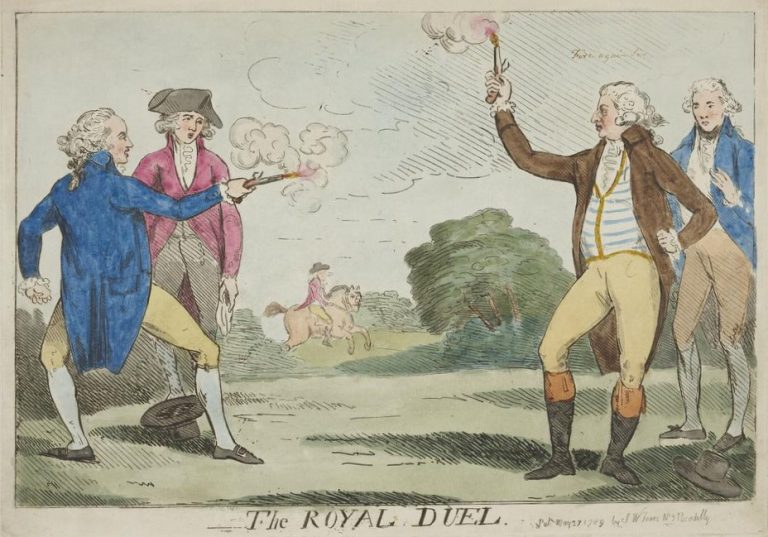
Lord Moira was a member of the Irish Parliament and a supporter of Catholic emancipation. He reportedly officiated as a second to the Duke of York, second son of King George III, in a duel with Colonel Charles Lennox, later the Duke of Richmond. He was also elevated to the Order of the Garter in 1812. Rawdon was vocal in supporting the ending of British involvement in the trans-Atlantic slave trade and was appointed Governor-General of India. He was later appointed Governor of Malta and died there in 1824.
Rawdon (far right) standing by during the 1789 ‘royal duel’ at Wimbledon Common (public domain)
He also appeared as a central character in American author, Stephanie Barron’s, 2006 mystery novel (with Jane Austen as the protagonist), Jane and the Barque of Frailty. However, his role in the murder mystery is not half as mad as his real life which very much reads like fiction.