
This blog is by Josie Darkins, an intern studying MA Public History at Queen’s University Belfast.
Lisburn-born Alexander Turney Stewart (1803-1876) rose to fame and fortune as the ‘Merchant Prince of Broadway’ after opening one of the world’s first department stores in New York and then opening an even bigger one down the street. From making brown paper bags in a grocer’s shop in Belfast to the heights of wealth with the means to help alleviate the poverty of those affected by the ‘Cotton Famine’ in Lisburn, what could be more intriguing than the story of Stewart’s life?
His death, as it turns out.
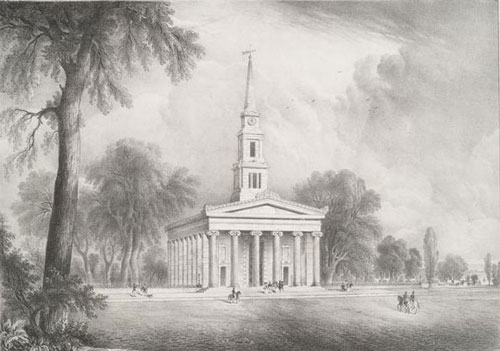
Stewart died on 10 April 1876 with a massive fortune. He was buried at St. Mark’s in Manhattan, the church he had joined upon arrival in New York. However, he did not rest in peace for long. At 8am one chilly November morning in 1878, the sexton and assistant sexton noticed some disturbed dirt and a terrible smell. Upon investigation, they found the un-embalmed remains of A.T. Stewart missing without a trace! ‘Body snatching’ by and for medical students was not unheard of, but the high-profile nature of the owner of the grave and the complete disappearance of the culprits was shocking to the public and confounding to the police.
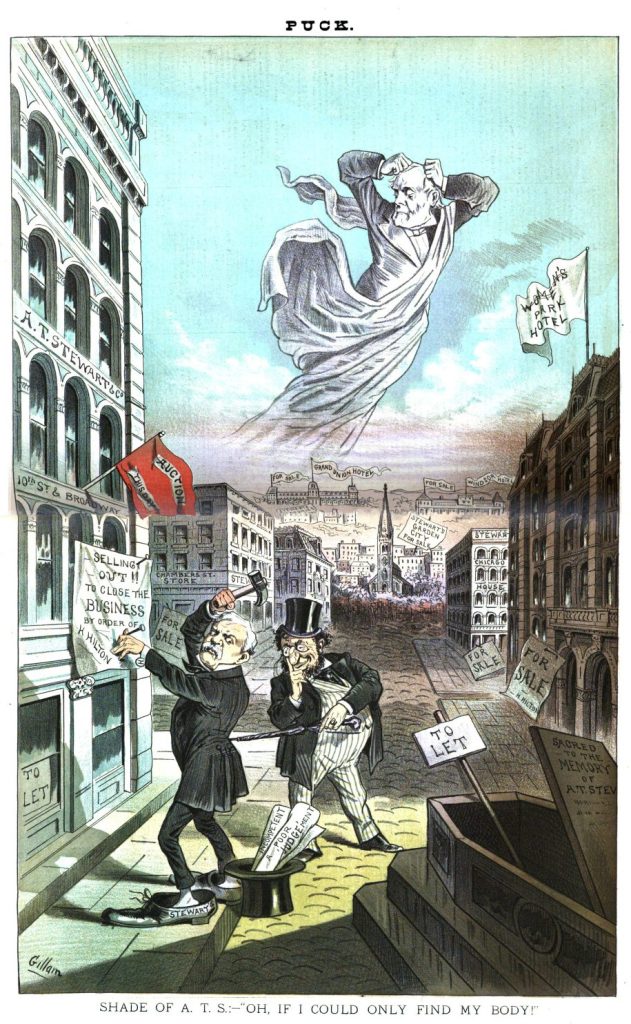
New York was gripped by the macabre mystery. The press was awash with sensational, but vague, accounts of the crime. Amateur sleuths among the public began to posit increasingly outlandish theories as to where Stewart’s earthly remains ended up – from destroyed by the family of a wronged ex-employee to dumped in a liquor barrel in Cuba. The Pinkerton Detective Agency got involved and mystics and clairvoyants wrote to the police to reveal they had seen where Stewart’s bones were being concealed in their dreams.
The reward for the return of the remains and capture of the criminals kept rising, but still the police made almost no progress. Stewart’s wife, Cornelia Mitchell Stewart (1802-1886), was deeply distressed by the whole affair and withdrew almost entirely from public life, leaving the matter in the hands of Stewart’s executor, Judge Henry Hilton.
There were several suspects, but all came to nothing. The lack of new developments caused the press to lose interest, until January 1879, when a prominent New York Lawyer, Patrick, H. Jones, claimed to receive a letter from the graverobbers. The letter contained screws, apparently from Stewart’s coffin, and claimed that Stewart’s remains were being held in Canada. The letter was signed ‘Henry G. Romaine’. Jones later received the silver name plate from Stewart’s coffin. Judge Hilton was told by ‘Romaine’ that the ransom for Stewart’s remains was $200,000 (around $6.5 million today!), but was unwilling to negotiate with the alleged criminals, so this too came to nothing. There was yet another hoax with letters sent to a private detective agency, which led to a dig but no body.
Some years later in 1885, a retired policeman published his memoirs which offered an ending to the Stewart story. He claimed that the ‘Romaine’ incident did not conclude with Hilton’s refusal to cooperate with the alleged graverobbers. Instead, Mrs Stewart continued negotiations herself and managed to talk the ransom all the way down to $20,000 (the same sum that Hilton had initially offered for the return of the remains when they went missing). According to the policeman, Mrs Stewart sent one of her nephews to carry out the exchange on a quiet road outside the city in the early hours of the morning. Like a detective novel, the men he met had donned masks and spoke very little, swapping a bag, offered as what remained of A. T. Stewart, for the ransom money. Apart from the assertions of this lone policeman, it seems there is no other evidence for or against this narrative. True story, or tall tale?
To this day, the whereabouts of Stewart’s bones remains inconclusive.