Lisburn's Dennis Light Four Fire Engine, which was sent to Belfast to assist with putting out the fires of the Blitz (LMILC.1996.64, purchase)
The Belfast Blitz was a series of four devastating German air raids that took place between 7 April and 6 May 1941 during the Second World War. Many thought Belfast was beyond the reach of German aircraft, but the city had vital wartime industries, such as shipbuilding and aircraft manufacturing which were key targets.
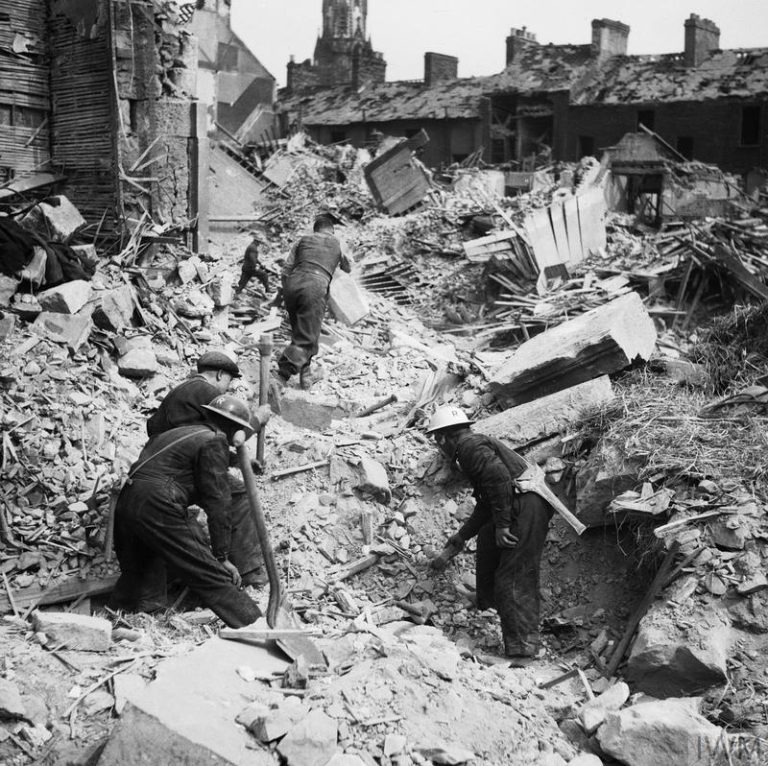
When the German bombers struck, Belfast was underprepared, leading to tragic consequences. Almost 1,000 people were killed, including 710 during the raid on Easter Tuesday, 15 April. With the exception of London, it was the greatest death toll in a single night of the Blitz. Belfast’s industries were crippled – some for days, others months or years – and 56,000 homes were destroyed or damaged.
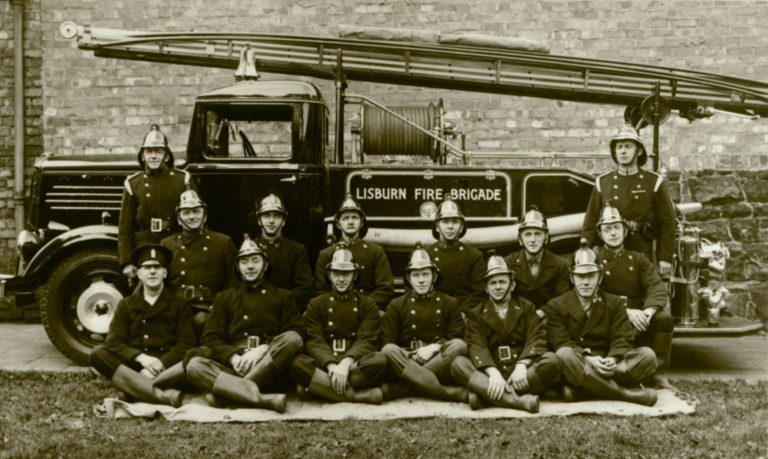
Lisburn Fire Brigade with their Dennis Light Four Fire Engine, 1939 (ILC&LM Collection)
The city’s emergency and civil defence services were unable to cope with the extent of devastation, particularly during the raid of 4-5 May when the city was set ablaze by around 96,000 incendiary bombs. Help arrived from other parts of Northern Ireland, and even over the border from neutral Éire.
Among those who came to Belfast’s aid were Air Raid Precaution squads from Lisburn, as well as the Lisburn Fire Brigade and Auxiliary Fire Service. The Fire Brigade went with their Dennis Light Four Fire Engine, which had been bought a few years before the Blitz from Isaac Agnew of Belfast at a cost of £1,180 (about £68,000 today). It was equipped with a 50ft ladder, ten 100ft hoses, held a 50 gallon watertank, and had a top speed of 60mph. The Fire Engine was decommissioned in 1952, and later acquired by the museum. It featured in the film ‘Closing the Ring’ (2007), which was directed by Richard Attenborough.
The flames of Belfast burning lit up the night sky and could be seen for miles. Lisburn was, of course, very close to Belfast and many residents feared that the Blitz would come to the town. Some fled to the safety of the countryside.
Lisburn was never bombed by the Germans, and it was much safer than Belfast. Evacuees poured into the town, some with no more than the clothes they were wearing after having had their home and belongings destroyed by the air raids. One of them recorded their experience in letter published in the Lisburn Standard of 19 April 1941:
I am an evacuee from Belfast and I just want to let you know how I and my husband and family of three were received in Lisburn … When we got off the bus a young lady and gentleman came over and asked us if we had any place to go for the night.
The next question was, ‘Have you had anything to eat?’ We were at once taken to a canteen and given the loveliest feed I have had for a long time. We were afterwards taken to a house by these kind people and – would you believe me – got hot water bottles put in our beds.
I shall never forget my first entry into Lisburn and the warm hospitality we received … If I had time I would love to tell you a lot more about these homely people. My husband and I say ‘Long live Lisburn.’