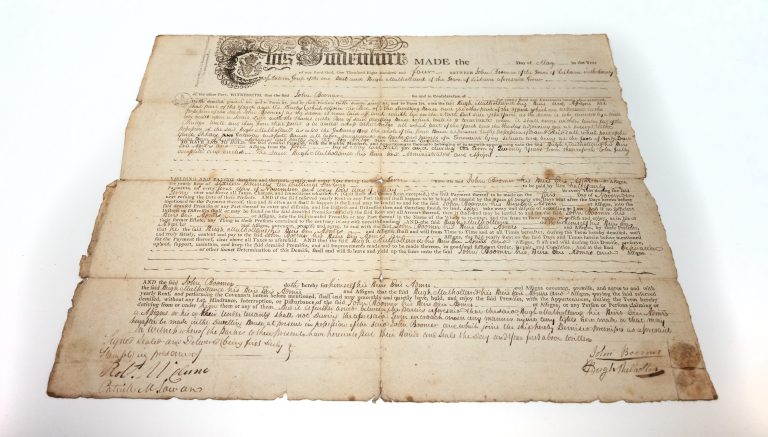
Lease Agreement between John Boomer and Hugh Mulholland for dwelling house and yards at the foot of Bridge Street, Lisburn, 1804 (LMILC.2009.93)
This blog is by Josie Darkins, an intern studying MA Public History at Queen’s University Belfast.
Born in Lisburn in 1839, Civil War General, St Clair Mulholland (1839-1910), would go on to become a celebrated veteran, author, and even an accomplished painter. He was part of a very large family. The oldest of his father’s second marriage, he had 16 surviving siblings and half-siblings. However, he was not the only notable Mulholland. His Lisburn-based relatives have their own stories to tell.
Lease Agreement between John Boomer and Hugh Mulholland for dwelling house and yards at the foot of Bridge Street, Lisburn, 1804 (LMILC.2009.93)
St Clair’s grandfather, Hugh Mulholland (1760-1833), owned a ‘lighter’ or barge on the Lagan Canal. In 1804, he acquired a 20-year lease for a house on Bridge Street. The Belfast News-Letter of 1816 commented that Hugh Mulholland had given two pounds to the Belfast Charitable Society which he had received as compensation from a man who had stolen coal from his boat. He married Elizabeth Richardson (1773-1818) and they had 10 children.
One of these children, St Clair’s father, Henry Mulholland (1796-1856), carried on this family business. He put an advert in the Northern Whig in 1839 to ‘acquaint the owners of lighters that he continues to execute the repairing and building of lighters in the most substantial manner, with expedition, and on moderate terms’. It is suggested that Henry converted to Catholicism. In 1817, Henry married Ann Turtle (1801-1835), a Protestant, and they had 13 children who were purportedly raised Catholic. Ann died in 1835.
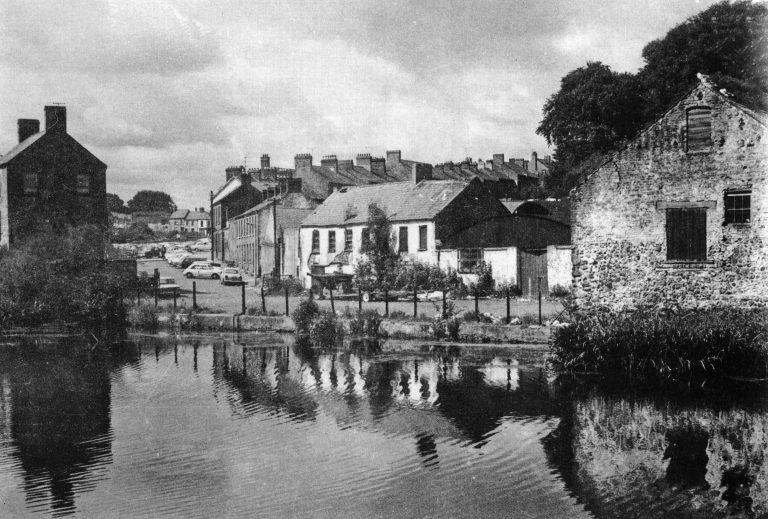
Henry married his second wife, Georgina Hester Agnes Sinclaire (b.1803), in 1839. She was part of a well-connected Belfast merchant family and is reported to have converted from Anglicanism to Presbyterianism to Catholicism throughout her life. They had four surviving children, the oldest of which was St Clair. The family lived at the quay in Lisburn until Henry advertised it to be let in 1843 as the ‘proprietor is leaving town’. In 1850 Henry moved his second family to Philadelphia, leaving the older children from his first marriage in Lisburn. In Philadelphia, St Clair found his footing as a landscape artist before trying his hand at being a soldier, just in time for the American Civil War to break out.
The Quay, Lisburn, which led onto Bridge Street in the distance, c.1950s
(ILC&LM Collection)
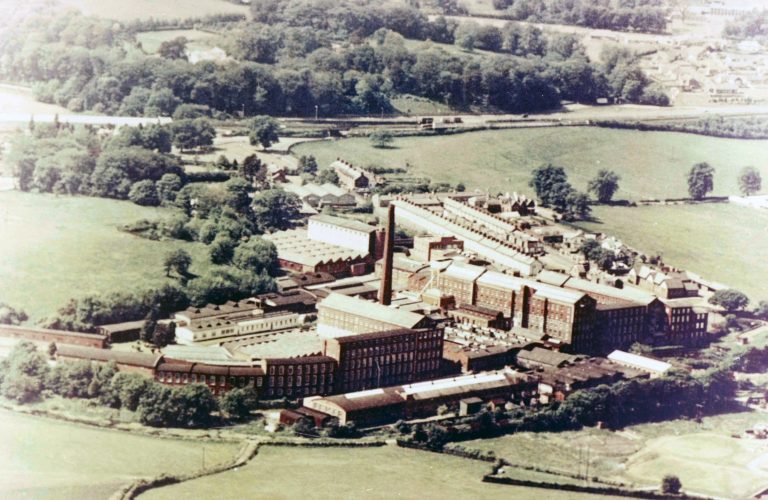
William Barbour & Sons, Hilden, c.1960s
Back in Lisburn, St Clair’s half-brother, Joseph Richardson Turtle Mulholland (1831-1916) was also making a name for himself, albeit on the battlefield of business. He worked in the linen trade for William Barbour & Sons, earning himself rapid promotion. Like his veteran brother, he became well-travelled, sourcing raw materials in Belgium and representing the company in America. He used his experience to become a manager for the Northern Spinning Company, cementing himself as a competent and committed businessman. He was also very active in public life, becoming a Justice of the Peace for Belfast, giving generously to the funds of the Royal Victoria Hospital and becoming so well known that he was used as a point of reference when St Clair’s exploits were recounted in the local newspapers.