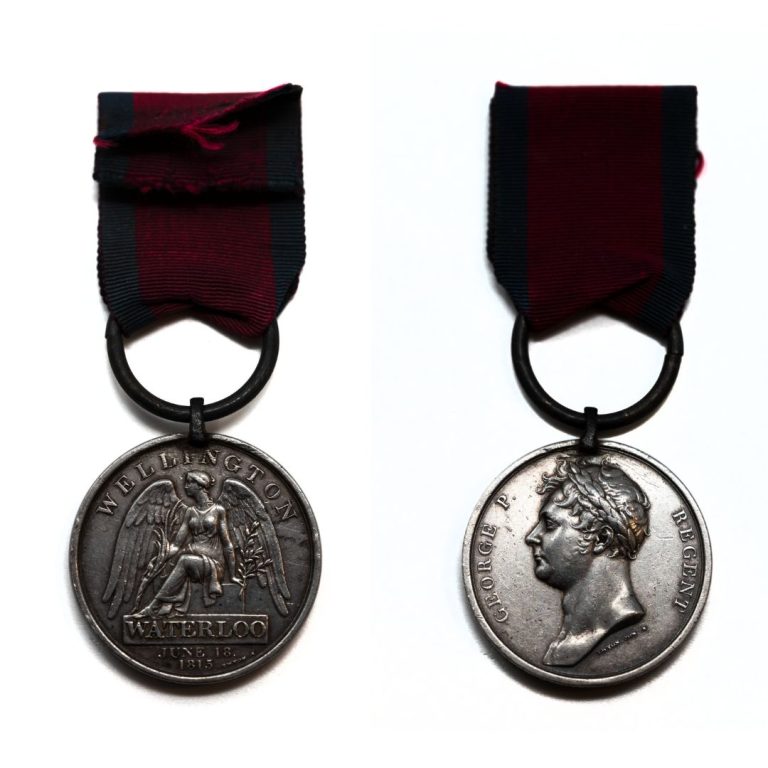
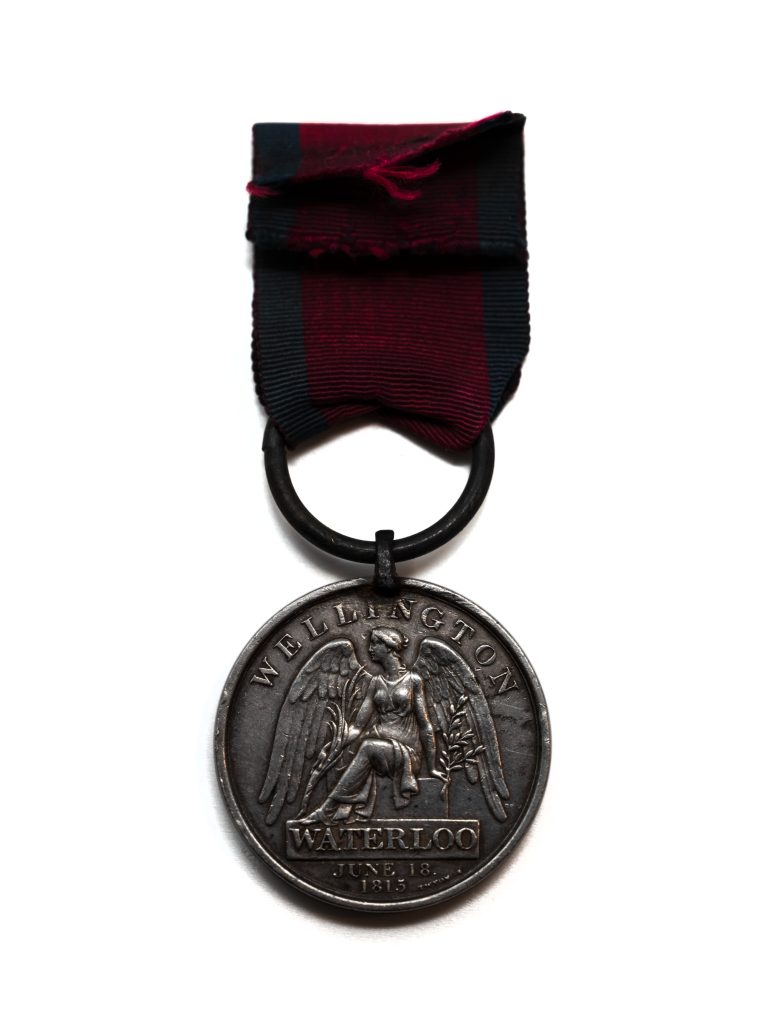
Reverse and obverse of the Waterloo Medal won by Private Arthur Elliott (LMILC.2025.036, purchase)
The Waterloo Medal was the first British medal given to all soldiers present during the Battle of Waterloo, regardless of rank. On one side is the winged figure of Victory, the words ‘WELLINGTON’ and ‘WATERLOO’, and the date of the battle, 18 June 1815. The other side bears a portrait of the Prince Regent (later King George IV). Each Waterloo Medal was inscribed with the recipient’s name along the edge.
This medal was awarded to Lisburn farmer, Private Arthur Elliott. He enlisted in the army in 1803, aged 18, possibly in the town’s Market House (now the Irish Linen Centre & Lisburn Museum). Serving with the 6th (Inniskilling) Regiment of Dragoons, he fought at the Battle of Waterloo where Arthur’s regiment formed part of the ‘Union Brigade’. It earned that name because it consisted of an English, a Scottish, and an Irish regiment. During the battle, he was severely ‘wounded in both hips and thigh by a lance’. Could this have happened during the Union Brigade’s decisive heavy cavalry charge?
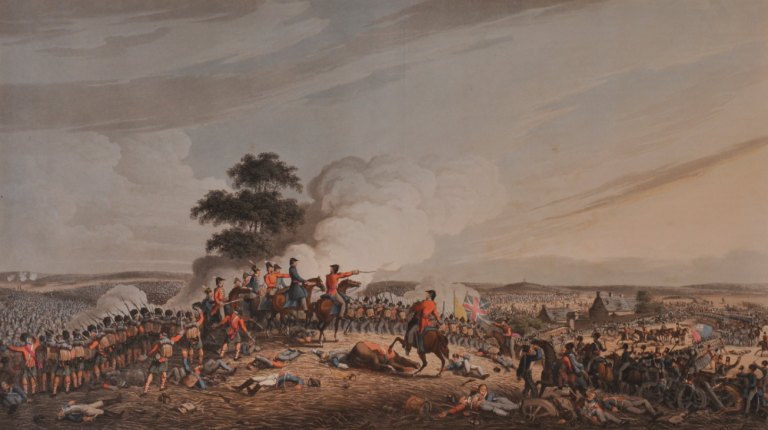
A view from Mont St. Jean of The Battle of Waterloo
Hand-coloured etching and aquatint by Robert Bowyer, 1816
(LMILC.2015.483, purchase)
Arthur survived the battle, but in 1817, records show that he was discharged from the army. The reasons were breathing difficulties, ‘bad health caused by frequent exposure to vicissitudes of heat and cold when on duty’, and the horrendous wound he received at Waterloo. He was given a small army pension until his death in 1854.